

en

For years, financing the transition to regenerative agriculture on farms has been a puzzle. On one side, voluntary carbon market standards (Verra, Gold Standard) for offsetting and climate contributions. On the other, emerging standards (LSRS, SBTi FLAG) for insetting and Scope 3. And separately, public programmes such as the CAP eco-schemes, or the Sustainable Farming Incentive in the UK. Three worlds, three logics, and no bridge between public and private finance.
The EU’s CRCF changes that. It is the first government-backed European quality standard for certifying soil carbon removals and emission reductions, and, by design, it is about more than carbon: every project must also improve soil health and biodiversity. One benchmark, all use cases. Here is what to understand, how it works, and why 2026 is a pivotal year for agriculture.
The CRCF, short for Carbon Removal and Carbon Farming Framework, is Regulation (EU) 2024/3012 and entered into force in December 2024. It is the first government-backed European quality standard for certifying high-quality soil carbon removals and emission reductions. Its promise fits in one sentence: one benchmark, all use cases.
1. The CRCF is the first European, government-backed framework for certifying soil carbon (Regulation EU 2024/3012), and it rewards more than carbon: soil health and biodiversity are built in.
2. One benchmark for several use cases: Scope 3 / CSRD (ESRS E1-7) reporting, integration into public subsidy schemes and regulations, and financing from outside the value chain (contribution or offsetting claims).
3. Certification rests on 4 quality criteria: quantification, additionality, long-term storage, sustainability.
4. Timeline: methodologies to be adopted in Autumn 2026, first CRCF units (from the 2027 harvest) reaching buyers in the first half of 2028.
5. Soil Capital sits on the CRCF Expert Group on behalf of the Climate Agriculture Alliance, and is already aligning its programme with the upcoming requirements.
The CRCF rolls out in stages. For agricultural projects, here are the milestones that matter.
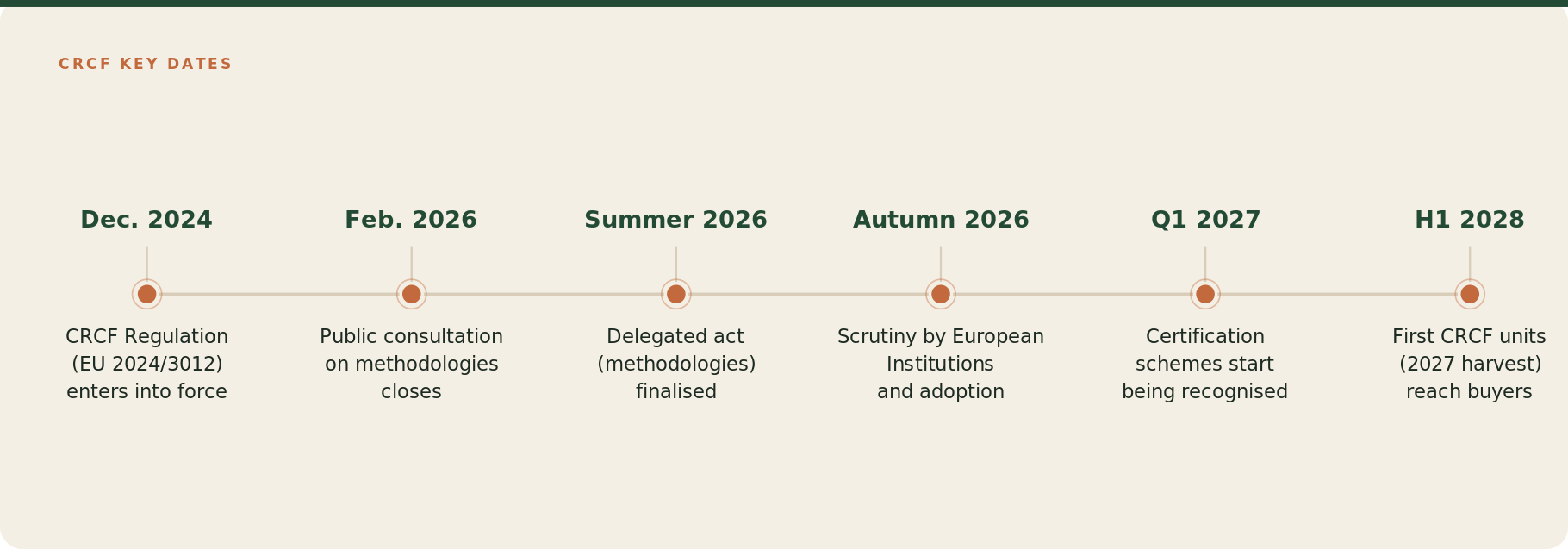
The reading is clear: the first agricultural CRCF units will reach buyers in the first half of 2028, based on the 2027 harvest. In other words, the projects started now are the ones that will generate the very first certified units.
Until now, agricultural carbon relied on voluntary standards and on public criteria, with no government-backed framework to unite public and private finance. For a value chain, that meant different rules depending on the intended use, projects impossible to compare, and a constant need to due diligence for integrity. For the farmer, it mostly meant having to choose one funding channel at a time, with no way to combine them.
The CRCF answers this fragmentation. It establishes a single set of practices, verified once, eligible for both private and public funding. That is a big step towards better economics for the farmer, and towards supply-chain transformation at scale. For agrifood companies, it means they no longer need to be the only ones paying for the transition.
The CRCF is not a standalone standard: it sits at the heart of the EU’s climate strategy. The Commission’s recent communication, A Vision for Agriculture and Food (February 2025), positions it as the tool to harmonise carbon farming and carbon removals across the Union. The Commission is also funding analysis on CRCF-based financing, including a Deloitte study for DG CLIMA on how to channel capital into carbon farming. And the framework is gaining concrete momentum: through the EU Bioeconomy Strategy (November 2025), the Commission launched the EU Buyers’ Club, a voluntary marketplace that aggregates demand for CRCF-certified units. For carbon farming, the Commission has signalled it could go further with EU-wide calls for CRCF projects, designed to attract both public and private investment and to bring land managers from the same region together into bidding consortia, developing projects at a large, transformative scale while delivering clear benefits for biodiversity and ecosystem protection.
To be certified, an activity must meet four cumulative quality criteria. None is optional, and it is their combination that gives a CRCF unit its value.
Robust quantification. Removals and reductions must be quantified rigorously. Where models are preferred, the most sophisticated process-based models are required, combined with soil sampling; a direct measure-and-remeasure approach is also permitted. Either way, uncertainty must be quantified, so you reason in net removals with uncertainty margins, not in theoretical estimates. Data rigour becomes the condition of market access.
Additionality. The activity must demonstrate regulatory surplus (going beyond what the law requires), an incentive effect (certification genuinely changes behaviour) and financial viability. The treatment of subsidies must be explicit, to ensure that the same public and private euro does not fund the same thing twice.
Long-term storage. The operator must ensure ongoing monitoring and put in place a liability mechanism in case of reversal: typically a buffer (a share of units held back to be retired in place of any that are later reversed), or insurance. This is the criterion that addresses permanence, that is, the guarantee that stored carbon stays stored over time.
Sustainability. Every activity must generate co-benefits for biodiversity and soil health. This is not an option, but an eligibility condition, which anchors the CRCF in an agronomic logic, not purely carbon accounting: the framework is, by design, about more than carbon.
Carbon stored in soil is reversible by nature, and the CRCF acknowledges this by requiring ongoing monitoring and a liability mechanism. A programme’s quality will therefore be judged largely on its ability to guarantee durability, not just to measure a stock at a single point in time. This is a point of convergence with the LSRS, the GHG Protocol’s Land Sector and Removals Standard, whose requirements for removals align strongly with those of the CRCF: process-based models and soil sampling with uncertainty calculation (with measure-and-remeasure also accepted), ongoing monitoring, and a demonstration of causality on the SBTi FLAG side. We break down these convergences in our CRCF and LSRS webinar.
Beyond the buffer the CRCF requires, which sets aside a share of units to cover any reversals, Soil Capital has designed a separate mechanism, its Permanence Fund. It is a financial incentive that rewards farmers for maintaining their practices over time. By aligning the farmer’s financial interest with the market’s need for permanence, it strengthens the credibility of the claims made by the companies that finance these units.
For agrifood companies, the CRCF provides a common, credible benchmark, directly usable for Scope 3 and CSRD (ESRS E1-7) reporting. CRCF units can also feed into public subsidy schemes and regulations, or support contribution claims (BVCM). Above all, by uniting public and private finance around a single standard, the CRCF ends a situation where agrifood players were often the only ones funding the transition. Certification relies on independent verification, which lets sustainability teams defend their claims with evidence, rather than relying on the reputation of a standard alone.
The CRCF’s main contribution is the unification of funding. A single set of practices, verified once, becomes eligible for both private and public funding. The regulation also recognises groups (cooperatives, producer organisations) as eligible actors, with group audits that pool costs and open certification to entire collectives rather than a few isolated farms.
For a cooperative or a trader, this opens the way to models where supply chain premiums, private funding and public support combine instead of excluding one another. That is a big step towards better economics for the farmer, and towards transformation at the scale of a whole value chain. Because the data produced is compatible with the GHG Protocol and SBTi FLAG, it also feeds directly into the reporting of companies along the value chain.
Soil Capital is fully committed to conforming with the CRCF once it is finalised. Criterion by criterion, the programme already meets the requirements: on quantification, we use a process-based model, DNDC (carbon and nitrogen), initialised with soil analyses, reporting net removals with uncertainty bands; on additionality, a public, ISO 14064-2 aligned and independently audited test, with explicit treatment of subsidies; on long-term storage, permanence backed by ongoing remote sensing, a buffer that sets aside a share of units to cover any reversals, and the Permanence Fund, a separate financial incentive for farmers to maintain practices over time; on sustainability, the monitoring of biodiversity, soil health and water through the Beyond Carbon indicators.
Soil Capital’s programme is already validated against recognised standards: it is aligned with ISO 14064-2 and has been assessed by SustainCERT against the GHG Protocol Scope 3 Standard and the draft LSRG. We will build on these existing alignments to confirm CRCF compliance once the final methodology is adopted. Depending on their needs, companies engage through insetting to reduce their Scope 3 within their supply shed, or through contribution beyond it.
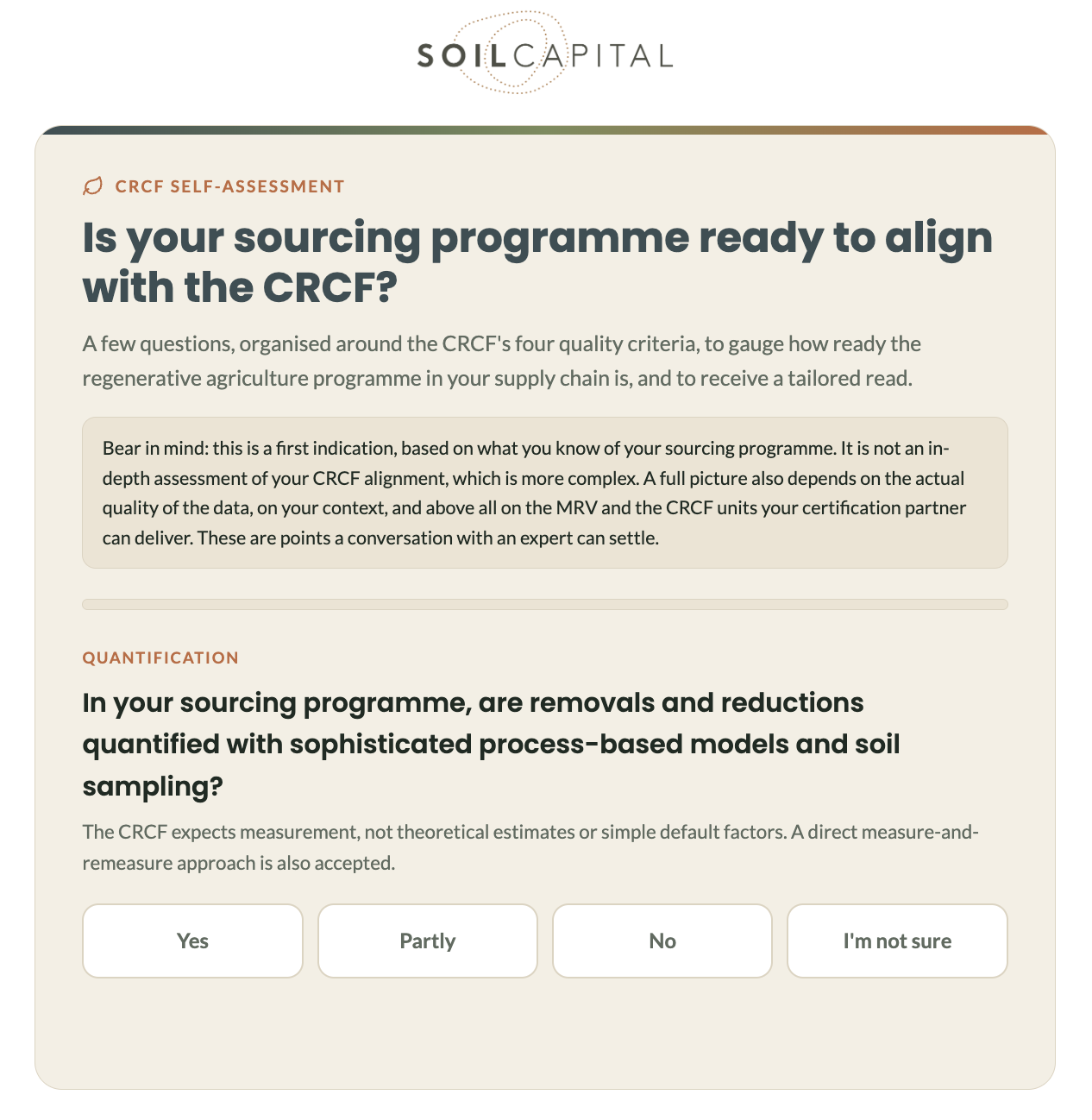
Assess your level of readiness in two minutes with our CRCF self-assessment. You get an indicative score and a few tailored pointers, and above all a clear read of the single most decisive factor: the quality of your certification partner’s MRV and the CRCF units it can deliver.


For years, financing the transition to regenerative agriculture on farms has been a puzzle. On one side, voluntary carbon market standards (Verra, Gold Standard) for offsetting and climate contributions. On the other, emerging standards (LSRS, SBTi FLAG) for insetting and Scope 3. And separately, public programmes such as the CAP eco-schemes, or the Sustainable Farming Incentive in the UK. Three worlds, three logics, and no bridge between public and private finance.
The EU’s CRCF changes that. It is the first government-backed European quality standard for certifying soil carbon removals and emission reductions, and, by design, it is about more than carbon: every project must also improve soil health and biodiversity. One benchmark, all use cases. Here is what to understand, how it works, and why 2026 is a pivotal year for agriculture.
The CRCF, short for Carbon Removal and Carbon Farming Framework, is Regulation (EU) 2024/3012 and entered into force in December 2024. It is the first government-backed European quality standard for certifying high-quality soil carbon removals and emission reductions. Its promise fits in one sentence: one benchmark, all use cases.
1. The CRCF is the first European, government-backed framework for certifying soil carbon (Regulation EU 2024/3012), and it rewards more than carbon: soil health and biodiversity are built in.
2. One benchmark for several use cases: Scope 3 / CSRD (ESRS E1-7) reporting, integration into public subsidy schemes and regulations, and financing from outside the value chain (contribution or offsetting claims).
3. Certification rests on 4 quality criteria: quantification, additionality, long-term storage, sustainability.
4. Timeline: methodologies to be adopted in Autumn 2026, first CRCF units (from the 2027 harvest) reaching buyers in the first half of 2028.
5. Soil Capital sits on the CRCF Expert Group on behalf of the Climate Agriculture Alliance, and is already aligning its programme with the upcoming requirements.
The CRCF rolls out in stages. For agricultural projects, here are the milestones that matter.
The reading is clear: the first agricultural CRCF units will reach buyers in the first half of 2028, based on the 2027 harvest. In other words, the projects started now are the ones that will generate the very first certified units.
Until now, agricultural carbon relied on voluntary standards and on public criteria, with no government-backed framework to unite public and private finance. For a value chain, that meant different rules depending on the intended use, projects impossible to compare, and a constant need to due diligence for integrity. For the farmer, it mostly meant having to choose one funding channel at a time, with no way to combine them.
The CRCF answers this fragmentation. It establishes a single set of practices, verified once, eligible for both private and public funding. That is a big step towards better economics for the farmer, and towards supply-chain transformation at scale. For agrifood companies, it means they no longer need to be the only ones paying for the transition.
The CRCF is not a standalone standard: it sits at the heart of the EU’s climate strategy. The Commission’s recent communication, A Vision for Agriculture and Food (February 2025), positions it as the tool to harmonise carbon farming and carbon removals across the Union. The Commission is also funding analysis on CRCF-based financing, including a Deloitte study for DG CLIMA on how to channel capital into carbon farming. And the framework is gaining concrete momentum: through the EU Bioeconomy Strategy (November 2025), the Commission launched the EU Buyers’ Club, a voluntary marketplace that aggregates demand for CRCF-certified units. For carbon farming, the Commission has signalled it could go further with EU-wide calls for CRCF projects, designed to attract both public and private investment and to bring land managers from the same region together into bidding consortia, developing projects at a large, transformative scale while delivering clear benefits for biodiversity and ecosystem protection.
To be certified, an activity must meet four cumulative quality criteria. None is optional, and it is their combination that gives a CRCF unit its value.
Robust quantification. Removals and reductions must be quantified rigorously. Where models are preferred, the most sophisticated process-based models are required, combined with soil sampling; a direct measure-and-remeasure approach is also permitted. Either way, uncertainty must be quantified, so you reason in net removals with uncertainty margins, not in theoretical estimates. Data rigour becomes the condition of market access.
Additionality. The activity must demonstrate regulatory surplus (going beyond what the law requires), an incentive effect (certification genuinely changes behaviour) and financial viability. The treatment of subsidies must be explicit, to ensure that the same public and private euro does not fund the same thing twice.
Long-term storage. The operator must ensure ongoing monitoring and put in place a liability mechanism in case of reversal: typically a buffer (a share of units held back to be retired in place of any that are later reversed), or insurance. This is the criterion that addresses permanence, that is, the guarantee that stored carbon stays stored over time.
Sustainability. Every activity must generate co-benefits for biodiversity and soil health. This is not an option, but an eligibility condition, which anchors the CRCF in an agronomic logic, not purely carbon accounting: the framework is, by design, about more than carbon.
Carbon stored in soil is reversible by nature, and the CRCF acknowledges this by requiring ongoing monitoring and a liability mechanism. A programme’s quality will therefore be judged largely on its ability to guarantee durability, not just to measure a stock at a single point in time. This is a point of convergence with the LSRS, the GHG Protocol’s Land Sector and Removals Standard, whose requirements for removals align strongly with those of the CRCF: process-based models and soil sampling with uncertainty calculation (with measure-and-remeasure also accepted), ongoing monitoring, and a demonstration of causality on the SBTi FLAG side. We break down these convergences in our CRCF and LSRS webinar.
Beyond the buffer the CRCF requires, which sets aside a share of units to cover any reversals, Soil Capital has designed a separate mechanism, its Permanence Fund. It is a financial incentive that rewards farmers for maintaining their practices over time. By aligning the farmer’s financial interest with the market’s need for permanence, it strengthens the credibility of the claims made by the companies that finance these units.
For agrifood companies, the CRCF provides a common, credible benchmark, directly usable for Scope 3 and CSRD (ESRS E1-7) reporting. CRCF units can also feed into public subsidy schemes and regulations, or support contribution claims (BVCM). Above all, by uniting public and private finance around a single standard, the CRCF ends a situation where agrifood players were often the only ones funding the transition. Certification relies on independent verification, which lets sustainability teams defend their claims with evidence, rather than relying on the reputation of a standard alone.
The CRCF’s main contribution is the unification of funding. A single set of practices, verified once, becomes eligible for both private and public funding. The regulation also recognises groups (cooperatives, producer organisations) as eligible actors, with group audits that pool costs and open certification to entire collectives rather than a few isolated farms.
For a cooperative or a trader, this opens the way to models where supply chain premiums, private funding and public support combine instead of excluding one another. That is a big step towards better economics for the farmer, and towards transformation at the scale of a whole value chain. Because the data produced is compatible with the GHG Protocol and SBTi FLAG, it also feeds directly into the reporting of companies along the value chain.
Soil Capital is fully committed to conforming with the CRCF once it is finalised. Criterion by criterion, the programme already meets the requirements: on quantification, we use a process-based model, DNDC (carbon and nitrogen), initialised with soil analyses, reporting net removals with uncertainty bands; on additionality, a public, ISO 14064-2 aligned and independently audited test, with explicit treatment of subsidies; on long-term storage, permanence backed by ongoing remote sensing, a buffer that sets aside a share of units to cover any reversals, and the Permanence Fund, a separate financial incentive for farmers to maintain practices over time; on sustainability, the monitoring of biodiversity, soil health and water through the Beyond Carbon indicators.
Soil Capital’s programme is already validated against recognised standards: it is aligned with ISO 14064-2 and has been assessed by SustainCERT against the GHG Protocol Scope 3 Standard and the draft LSRG. We will build on these existing alignments to confirm CRCF compliance once the final methodology is adopted. Depending on their needs, companies engage through insetting to reduce their Scope 3 within their supply shed, or through contribution beyond it.
Assess your level of readiness in two minutes with our CRCF self-assessment. You get an indicative score and a few tailored pointers, and above all a clear read of the single most decisive factor: the quality of your certification partner’s MRV and the CRCF units it can deliver.
No. The CRCF is a voluntary certification framework. But it is the first government-backed European quality standard, and it is being actively integrated into EU climate policy, which makes it the quality benchmark the market is converging on.
The CRCF certifies soil carbon removals and emission reductions, in the form of CRCF units, from a single set of practices verified once. Every project must also improve soil health and biodiversity. These units can then be used for Scope 3 and CSRD reporting, for integration into public subsidy schemes and regulations, or for contribution claims (BVCM).
The LSRS (Land Sector and Removals Standard) is the GHG Protocol’s standard for land-sector carbon accounting in corporate reporting. Its requirements for removals align strongly with those of the CRCF (process-based models, soil sampling, uncertainty, ongoing monitoring), which makes it possible to build a coherent approach between certification and reporting.
The first CRCF units, from the 2027 harvest, should reach buyers in the first half of 2028.
The CRCF marks a turning point for European agricultural carbon: for the first time, a government-backed quality standard unites public and private finance around a single benchmark, usable for Scope 3 reporting, public subsidy schemes and contribution. Its four quality criteria, its growing role in EU policy and its now clear timeline make it the new market reference, and one that, by design, rewards healthier soils and biodiversity as much as carbon.
For a value chain and for a company alike, the conclusion is the same: the first certified units will come from the 2027 harvest, and preparing now, by strengthening data and supporting farmers, is how you give yourself the means to be part of the first wave.
Go further: watch our CRCF and LSRS webinar, or discover how to reduce your Scope 3 through insetting within your supply shed.
